Programming languages abstract out the spatial topology of memory by modelling it as a flat array. This model attaches a similar cost to all memory accesses. In reality, memory layout influences the speed at which CPU can fetch the data required to carry out a computation.
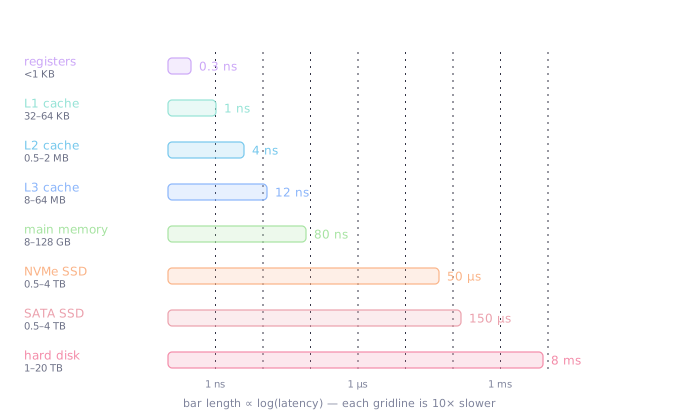
DRAM is connected to the CPU by a memory bus. In addition, CPUs have a bunch of extremely fast but tiny caches L1/L2/L3 etched at close proximity. Accessing data from the caches is orders of magnitude faster than accessing data from main memory.
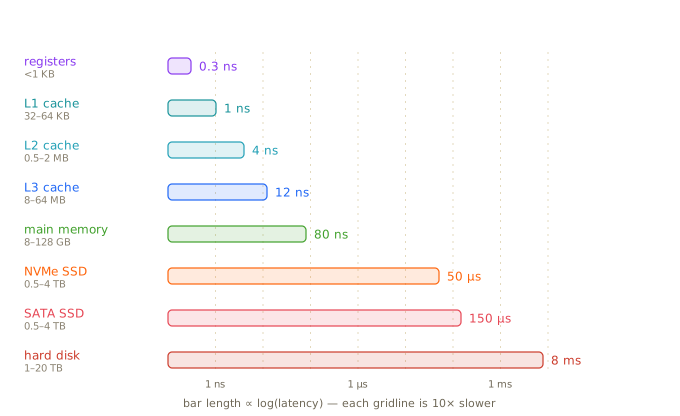
To perform computations efficiently, we need to think about how our programs access data. We should tune our access patterns to be cache friendly. In the post, I will particularly discuss how data layout can affect the cache locality.
A tale of two structs
We have two structs MissileGood and MissileBad with the same fields albeit in a different order. In my game, at the end of the loop, I need to check an array of missiles to identify disabled missiles and set the visible flag to false.
struct MissileGood {
    bool is_visible, is_disabled;

    float x, y, z;
    float velocity_x, velocity_y, velocity_z;
    float damage, explosion_radius, fuel, lifetime;
    float launch_angle, homing_strength, turn_rate, max_speed;
    float acceleration, distance_traveled, arming_time, explosion_delay;
    float smoke_duration, trail_length, gravity, drag;

    double seeker_temperature, guidance_error, signal_strength, flight_time;
};MissileGood.c
struct MissileBad {
bool is_visible;
float x, y, z;
float velocity_x, velocity_y, velocity_z;
float damage, explosion_radius, fuel, lifetime;
float launch_angle, homing_strength, turn_rate, max_speed;
float acceleration, distance_traveled, arming_time, explosion_delay;
float smoke_duration, trail_length, gravity, drag;
double seeker_temperature, guidance_error, signal_strength, flight_time;
bool is_disabled;
};MissileBad.cBenchmark
I have built a simple benchmark to update is_visible flag conditioned on the is_disabled for an array of structs. I ran the same code for both structs. I used kperf.h to read the CPU counters and get the measure of cache misses (Made me realise that I love perf). I have also randomized the access to disable the hardware prefetcher; discussing this is out of scope.
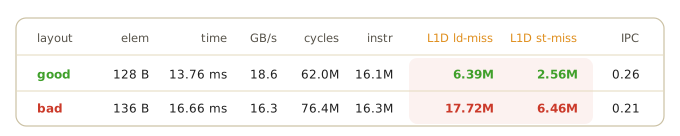
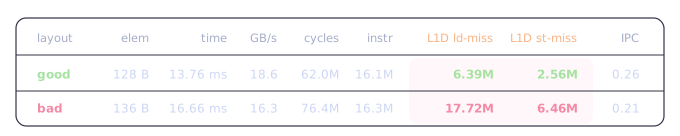
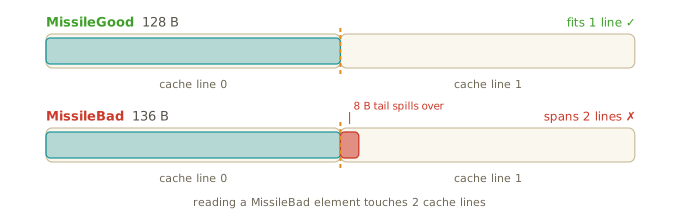
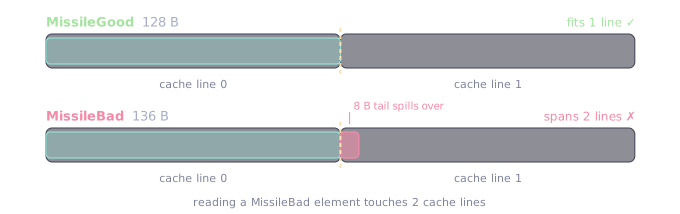
I ran the benchmark on Apple M4 with 128 byte cache line. The good struct (128 bytes) fits a cache line whereas the bad one spans two cache lines (136 bytes). The size of the data in the bench is not too big, so there is only a marginal wall clock improvement, but if you see the cache misses, the bad one has nearly double the cache misses compared to the good struct.
If you are using clang you can use the flag -Xclang -fdump-record-layouts to see the struct paddings and field offsets. Solely relying on compiler specific flags or extensions can affect code portability; it is essential to study the language ABI and have some general awareness of how data is laid out in memory to write performant cache friendly code.
Towards SOA
Instead of trying to fit the data in a struct and access it in an array, where we cannot avoid paddings in the struct when we have heterogeneous types (some ISAs mandate aligned access), we can have an array for each field of the struct; this way we can avoid padding between the elements. This paradigm is called structure of arrays (SOA) and deserves a standalone post.